

Smart buildings and building management industries are booming like never before! They are the need of the hour and are only growing in leaps and bounds. Responsive buildings are taking over enterprise management systems, revolutionizing the way buildings are viewed. The facility management market is facing its best years due to such building automation approaches.
With smart building optimizations, hybrid workplaces are regularizing working from the office and tenants are moving back to their residents. There is a rise in travel and tourism, challenging the hospitality sector to be all the more prepared for the same. Post Covid-19, every industry is slowly reverting back to normal. So, how is it going to impact the FM market?
We started our blog section by introducing you to facility management, its importance in the present digital era and how companies can escalate their business growth. We further explored the various[ facility management software available in the facility management market in 2023.
We discussed the importance of FM technology in corporate real estate. In this blog section, let us dive deeper into the economic and statistical aspects of the FM market.
2023 FM Market Size, Forecast, Future and Growth Report
 The global facility management market growth report in 2021 was $42.2 billion. According to Fortune Business Insights, the global facility management market size is expected to experience substantial growth. Its value is projected to increase from $1,291.6 billion in 2023 to $2,031.4 billion by 2030, reflecting a Compound Annual Growth Rate (CAGR) of 6.7% during the forecast period.
Facility management is no longer viewed as a mere support function. The bottom line is, today, it directly impacts the organization's performance. Automation of building processes using FM software ensures organizations create a conducive environment and agile workspaces. Facility managers can effectively manage their facilities while ensuring a foolproof plan to enhance their operational efficiency.
The future FM market growth is built on trends. There are 5 key trends shaping the future of facility management in 2023.
Click here to know more about these trends governing the FM industry!

Facility management includes a wide range of activities and responsibilities. It can be tailored and catered to as per industry requirements. The branches of FM stretch to the management of physical assets and systems, including buildings, infrastructure, equipment, and services. The future and forecast of facilities management is molded by advancements in technology. It revolves around maintenance management, IoT (Internet of Things), Machine Learning (ML), Artificial Intelligence (AI), smart and futuristic buildings etc.
The main objective of an efficiently managed building is to create and maintain a safe and productive environment. Facility managers are useful in optimizing each building process. They must ensure adequate assets are available in the inventory alongside their proper utilization. Moreover, when the tasks become daunting, facility managers can miss a task or two.
The human brain limits the extent of FM application and data storage. There is room for error, mismanagement or communication gap. All of which can be bridged by modernizing BMS (Building Management System) approach. These FM software use smart AI technology, sensors etc. to store and comprehend data. This makes the process hassle-free and helps organizations align their facility strategies with overall business objectives.
1. Global Economic Uncertainty:
The FM industry is fluctuating due to global economic uncertainty. The economic downturns or recession has impacted all industries and markets. It is bound to reduce budgets for the FM industry thereby, directly resulting in slower market growth.
With the heavy decline in the global economy, the FM market should also stay at bay. There are several factors responsible for the global growth slowdown in 2023. It includes the Ukraine and Russia War, rising interest rates, and ongoing supply chain disruptions. Besides, the IMF believes that the global economy is recovering at a phase after the pandemic.
2. Technological Advancements:
There are rapid advancements in technology that are transforming the FM market. Leveraging these technologies offer major benefits for organizations. But, it does come with their own set of challenges like infrastructure, staff training, cybersecurity etc.
3. Sustainability and Environmental Concerns:
The present scenario calls for an increased focus on environmental factors, net-zero emissions, vast reduction, energy management etc. These requirements could add more to expenses on the long run if not implemented in the initial stages.
4. Talent Management and Skills Gap:
There is a constant need for staying aligned with market trends. There is a requirement for diverse skills, technical expertise, project management, and ability to comprehend and understand these complex systems. One must invest in employee development programs to ensure sustained market growth.
5. Competitive Landscape
The FM market is highly competitive! There are numerous providers and FM software systems available in the market. Tracking trends, innovating , improvising and customizing can ensure long-term benefits and strong client relationships. It is a crucial step to maintain a competitive edge ad stand out in the FM market.
These challenges must be addressed head-on! You must employ strategies, follow trends and adapt to current market dynamics to grow, strive and meet the evolving needs of clients in a dynamic business environment.
Navigating the Global Facility Management Market: 2022-2027
The US facility management industry in the United States has experienced substantial growth in recent years. Many industries are focusing on transforming digitally and hence there is a lot of hustle seen in the FM market. It has impacted the market size and share of the facility management sector.
The statistical analysis by Mordor Intelligence displays the considerable expansion in the facility management industry in the year 2022-2027.
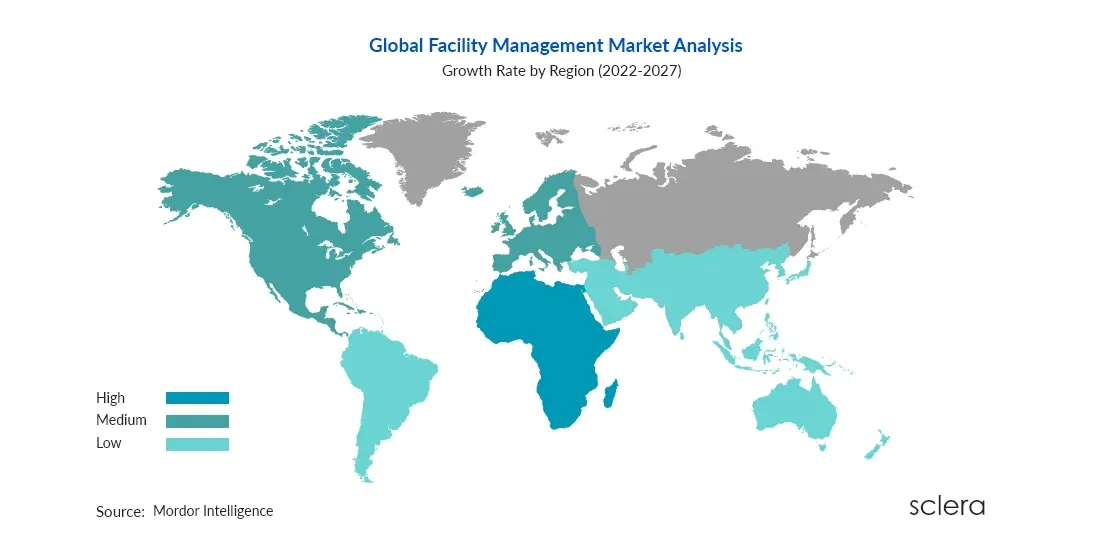 Decades of industry experience of prominent players play a major role in fragmenting the FM market. This fragmentation is useful to bring diversity in smart facility management and related services offered.
There is a constant need for high-quality services and tailored solutions in BAS (Building Automation Systems). There are unique challenges and requirements across industries in different facilities. To combat these unique challenges, it is required to implement a touch of modernization in facility management.
Let us help you take the first step towards smarter buildings in 2023!
Contact us for smart facility management solutions.
Conclusion
FM companies leverage technological advancements such as computer-aided facility management (CAFM) systems like CMMS or EAM software. They integrate with Internet of Things (IoT) devices, sensors, ML (Machine Learning), and AI (Artificial Intelligence) for data analytics. These data are useful to optimize operational efficiency, streamline workflows, and create maintenance strategies. It can help organizations to achieve excellent customer experience and deliver exemplary services to their clients.
The facility management industry is driven by trends and technological advancements. Due to this, there are significant transformations in the US facility management market. These trends also focus on the sustainability sector and green building initiatives. There are Government funded projects and green building certifications like LEED backing the facility management industry.
It is advisable to stay in alignment with the trends and technological advances. Learn more on how to optimize your buildings and create agile workspaces for your employees. Work to enhance employee engagement and productivity by following a few steps. All of this can be achieved alongside sustainability and net zero carbon emissions!