
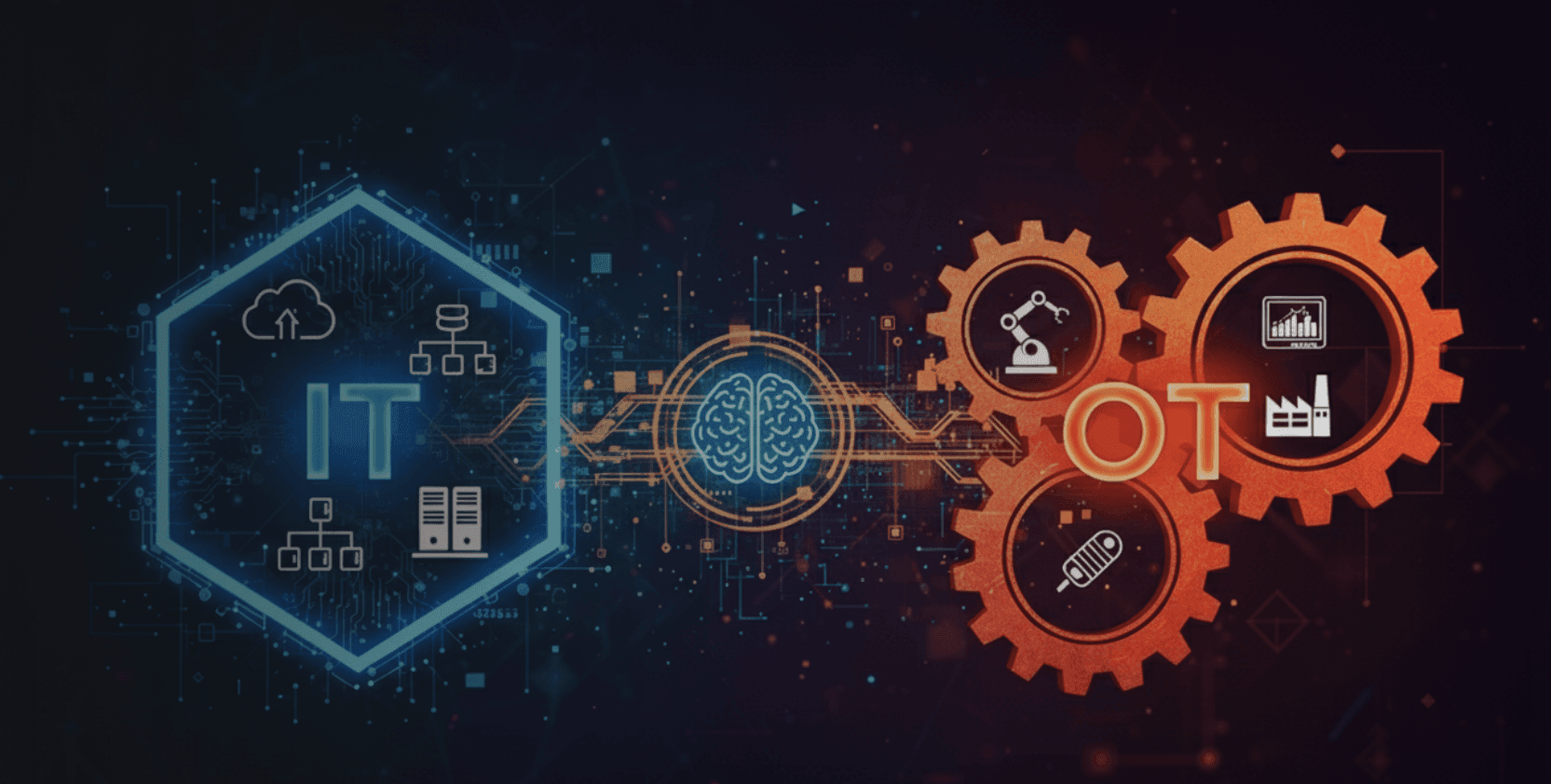
The need for interdependence is ever-increasing in today’s digital landscape. With modern infrastructure incorporating IT-OT convergence, management and maintenance of contemporary facilities have taken precedence. Formerly, information technology (IT) and operational technology (OT) teams managed their responsibilities separately. Today, these two domains have combined forces to create “smart buildings” that connect every asset.
IT teams manage servers, networks, and data while OT teams oversee physical machinery, like HVAC systems, elevators, and industrial controllers. This technological integration brings operational efficiency; however, it also introduces new challenges for maintenance. For example, an IT network failure could disrupt the Building Management System (BMS), preventing it from receiving crucial alerts from an overheating HVAC unit. This scenario emphasizes the need for independent systems to work in a unified manner, with facility managers bridging the gap between these two disciplines. As a result, both digital and physical infrastructures are maintained to ensure operational continuity and prevent costly downtime.
IT-OT Convergence Powers Smart Maintenance
Effective facility management relies on understanding the impact of IT-OT convergence on traditional maintenance practices. When your IT infrastructure is directly linked to your building's operational machinery, a siloed approach is not considered feasible. For instance, a data center's cooling system is an OT asset, but the servers it cools are IT assets. A failure in one directly impacts the other. Hence, a cohesive maintenance strategy provides complete visibility and control over the entire connected digital ecosystem.
Unifying visibility for proactive management
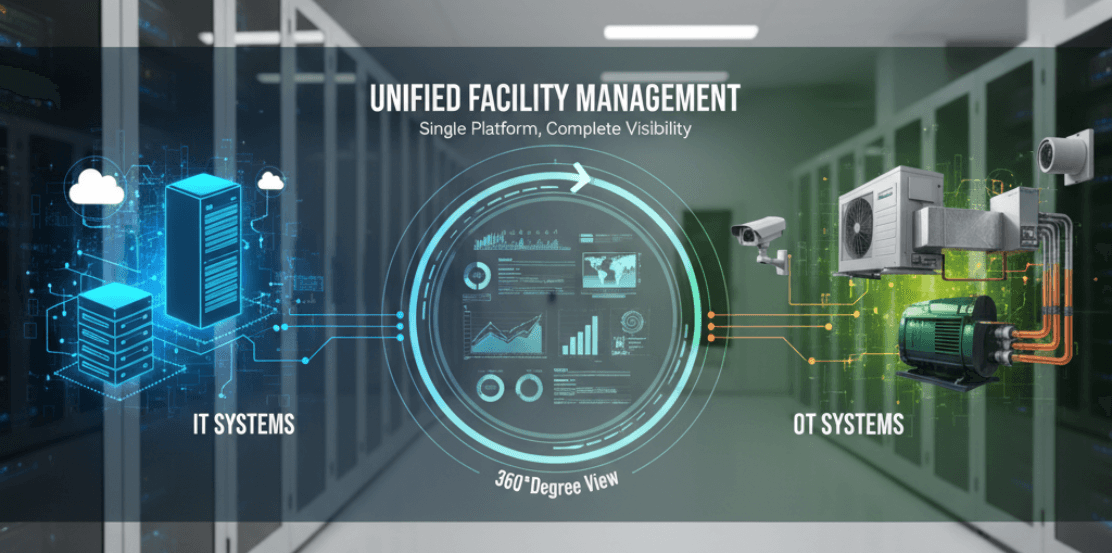 Illustration of IT-OT convergence in unified facility management, connecting IT systems and OT systems through a centralized platform for complete visibility and 360-degree insights.
A primary benefit of combining IT and OT is the ability to achieve unified facility management. Instead of juggling multiple, separate monitoring tools—one for your servers, another for your HVAC, and a third for your security systems—a single platform can provide a 360-degree view. This integrated dashboard allows teams to view the relationships and dependencies between different assets.
This level of real-time facility monitoring is a stroke of genius. Imagine receiving an alert that a server room's temperature is slowly rising. A unified system can automatically match this with data from the corresponding air conditioning unit, revealing the root cause, such as a clogged filter or a failing compressor. This allows the maintenance team to address the issue proactively before the servers overheat and cause a catastrophic failure. Key benefits include:
• Comprehensive health monitoring: Track the performance of both IT and OT assets from a single interface. • Dependency mapping: Understand how a failure in one system, like a network switch, might affect another, like the automated lighting system. • Faster root cause analysis: Quickly identify the source of a problem by analyzing corresponding data from multiple systems, reducing diagnostic time.
Synchronizing workflows for greater efficiency
Unified visibility eventually leads to synchronized maintenance workflows. Centralized maintenance management ensures that when an issue is detected, the right teams are dispatched with the right information. In a connected environment, an alert doesn't just trigger a single work order; it can initiate a coordinated response between IT and facilities teams. This is a significant step up from the traditional method, where a problem reported by one team might take hours or days to be communicated to another.
Sclera is at the forefront of enabling this transformation. Our platform helps organizations tackle the challenge of silos between IT and OT, creating a single source of truth for all facility-related data. By integrating data from diverse systems, Sclera helps businesses move towards a model of predictive maintenance analytics. This approach uses historical data and machine learning algorithms to foretell potential equipment failures before they occur. For example, the system can analyze vibration patterns in a generator and predict a bearing failure weeks in advance, allowing for scheduled, non-disruptive maintenance.
IT-OT Convergence—The Backbone of Intelligent Operations
True IT-OT convergence paves the way for the future of smart building maintenance. The result? A predictive, automated, and data-driven practice. The massive amount of data generated by connected IoT sensors and devices is a source of wealth. When analyzed correctly, it provides deep insights into the operational health of a facility. It is estimated that a smart commercial building can generate gigabytes of data each day, offering countless opportunities to optimize performance.
From reactive to predictive maintenance
They say prevention is better than cure. The traditional maintenance model is often reactive—fixing things after they break. From a business perspective, this approach is costly, disruptive, and inefficient. Predictive maintenance analytics changes this paradigm by using data to forecast future problems. By analyzing trends, anomalies, and patterns, facility managers can schedule maintenance tasks based on actual need rather than inconsistent timelines.
Consider an industrial pump. Instead of servicing it every six months, sensors can monitor its pressure, flow rate, and temperature in real-time. Analytical models can then use this data to determine the optimal time for service, extending the asset's lifespan and preventing unexpected breakdowns. This data-first approach offers significant advantages:
• Reduced downtime: Proactively addressing issues minimizes unexpected failures and their impact on operations. • Lower maintenance costs: Servicing equipment only when required saves money on labor and spare parts. • Improved safety: Identifying potential hazards, like an electrical fault or a gas leak, before they become critical threats.
Achieving cross-domain intelligence
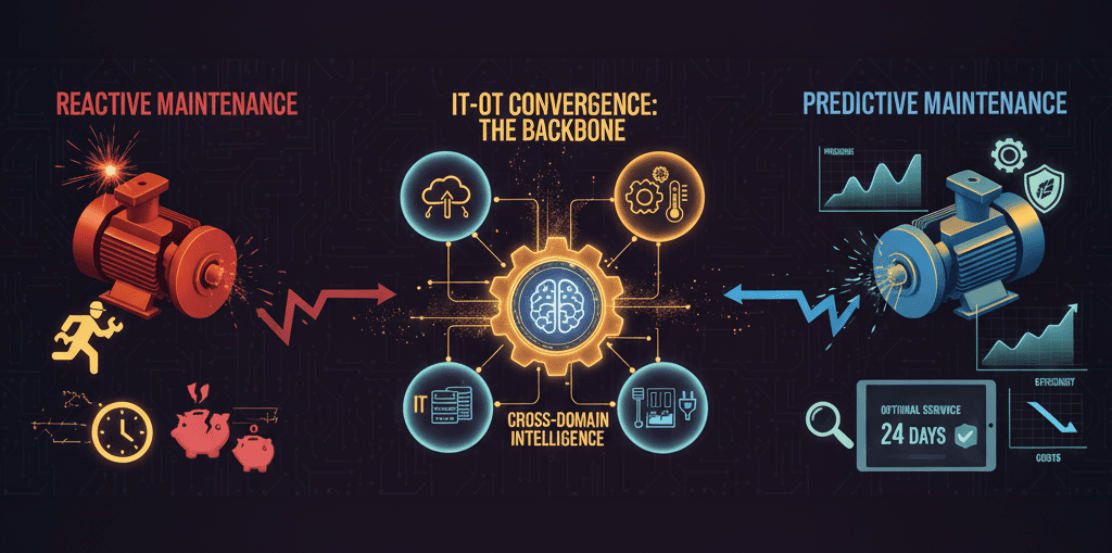 Concept of IT-OT convergence driving predictive maintenance, showcasing the evolution from reactive to proactive operations through cross-domain intelligence and data analytics.
IT-OT convergence aspires to achieve cross-domain intelligence. Since real-time insights into data encourage proactive action, this unlocks a new level of integration between IT and OT. This provides ample room for sophisticated automation and optimization. For example, data from the room booking system (IT) could automatically adjust the lighting and temperature in a conference room (OT) for an upcoming meeting. Post the meeting, the system could power down non-essential services to conserve energy.
This intelligent automation depends on a robust foundation of real-time facility monitoring and centralized maintenance management. It ensures that all systems not only communicate but also work together to enhance efficiency, sustainability, and the occupant experience.
Accelerating IT-OT Convergence Success—Sclera
As organizations adopt interconnected systems, the focus has moved from managing assets to orchestrating intelligence through domain interdependence. The ability to unify digital and physical environments transforms maintenance from a reactive response into a proactive, data-driven advantage.
This innovation stimulates resilience, foresight, and sustainability in organizations. By integrating real-time insights, predictive analytics, and automated workflows, facility managers can prevent disruptions before they occur, optimize resource usage, and extend asset lifecycles.
Sclera empowers organizations to step away from domain silos and branch coordination between IT and OT, creating a unified operational ecosystem where every asset and alert is intelligently monitored and actioned. Through our advanced platform, we enable seamless facility data integration, predictive maintenance analytics, and overall visibility across systems. Coexistence and interconnectedness are the way forward for IT and OT, and Sclera is just the right platform to drive this transformation.

