

Vendor access is inevitable in today’s dynamic business environment. Sectors engaging in critical infrastructure like energy, water, and transportation tend to outsource specialized tasks to third-party vendors. Although beneficial, these partnerships introduce grave third-party risks when not vetted thoroughly. Hence, a robust security protocol is imperative to ensure that every potential entry point is monitored for looming threats.
The traditional "castle-and-moat" security model, which assumes a secure internal network as trustworthy, does not suffice in today’s digital landscape. This outdated approach fails to account for contemporary, complex threats targeting supply chains and third-party vendors. A single compromised vendor credential could grant a cyber attacker broad access, leading to fatal operational disruptions or data breaches. Effective third-party risk management requires a modern, vigilant approach to cybersecurity.
Today’s business paradigm necessitates organizations to shift their focus from trusting vendors to verifying their authenticity. Companies need to implement frameworks that scrutinize every access request. This way, employees are able to function efficiently without compromising on the security of the vital systems. Security leads to a resilient and agile operational environment.
Why Vendor Access Needs Zero-Trust Controls in Critical Operations
A traditional perimeter-based security model exposes a landscape with significant blind spots invisible to the naked human eye. When third-party consultants, technicians, or maintenance crews request system access, your protected business environment becomes vulnerable. Vendor access management enforces zero-trust principles, ensuring that only the most basic permissions are granted. However, the challenge lies in granting access only to the right person, for the right reasons, and for the appropriate duration of time.
Without stringent controls, you risk exposing sensitive operational technology (OT) and information technology (IT) systems to malicious cyberattacks. A comprehensive risk assessment often reveals that vendor-related vulnerabilities are among the most critical threats. According to recent studies, a significant percentage of security breaches stem from third-party partners. This emphasizes the urgent need for a better risk management strategy, one that moves beyond simple password policies and periodic reviews. The goal is to achieve meticulous control over every interaction a vendor has with your network.
Securing Vendor Access with Identity, MFA, and Micro-Segmentation
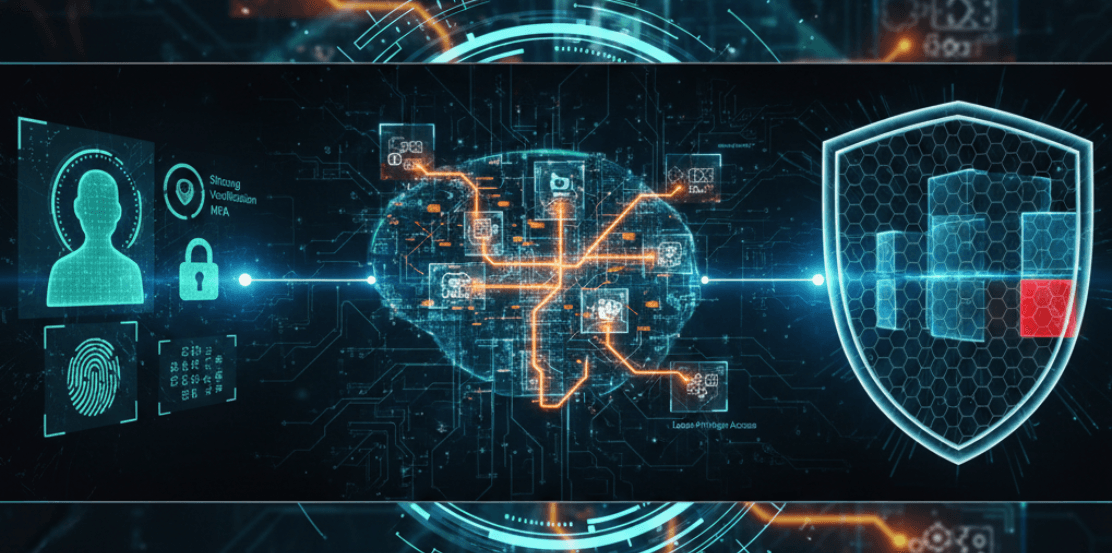 A futuristic cybersecurity interface showing biometric authentication, identity verification, and network protection layers centered around a digital brain and shield, illustrating secure vendor access and least-privilege control in critical systems.
A zero-trust architecture radically changes how we approach security by eliminating the concept of a trusted internal network. It operates on the principle that no user or device, whether inside or outside the network perimeter, should be trusted by default. Instead, every access request must be authenticated, authorized, and constantly monitored. This model is perfectly suited for managing the complexities of third-party interactions.
Implementing a zero-trust network for vendors involves several key components: - Strong Identity Verification: Before granting any access, the system must verify the identity of the user and their device. This goes beyond a simple username and password, often incorporating multi-factor authentication (MFA) to ensure the person is who they claim to be. - Least-Privilege Access: Users are granted the minimum level of access required to perform their specific tasks. A maintenance technician, for example, should only be able to access the specific systems they are servicing, and nothing more. - Micro-segmentation: The network is broken down into small, isolated zones. If one segment is compromised, the breach is contained and cannot spread to other parts of the network. This is crucial in critical infrastructure, where isolating a non-essential system from a core operational one can prevent a mishap.
By embracing zero-trust security, organizations can confidently grant vendors the access they need to perform their duties while visibly reducing the attack surface. This framework ensures that even if a vendor’s credentials are stolen, the potential damage is largely limited.
Vendor Access Control Made Smarter with Zero-Trust Automation
 A futuristic industrial control room where engineers monitor biometric dashboards and revoke permissions in real time, highlighting secure vendor access management through authorization windows, access control, and activity analytics.
Implementing the principles of zero trust into practice requires powerful tools. This is where impactful platforms like Sclera come into play. Sclera is designed to implement a robust zero-trust security model specifically for managing vendor access in complex industrial environments. It translates the theoretical concepts of zero trust into tangible, achievable workflows.
Sclera strengthens third-party risk management by providing specific, role-based access control. Instead of giving a vendor company broad network access, you can create specific, time-bound authorization for individual technicians. For example, a contractor hired to update a specific programmable logic controller (PLC) can be given access only to that device, only during their scheduled maintenance window. Once the task is complete, their access is automatically revoked.
Furthermore, Sclera creates a thorough audit trail of all vendor activity. Every command executed, every file accessed, and every connection made is logged and recorded. This provides complete visibility and transparency into what third parties are doing on your network. These audit logs are invaluable for: - Incident Response: In the event of a security incident, you can quickly trace the source of the issue and understand its impact. - Compliance: Many industries have strict regulatory requirements for logging and monitoring. Automated audit trails assist organizations in demonstrating compliance with standards. - Proactive Threat Hunting: Security teams can analyze logs to identify suspicious patterns or anomalous behavior, allowing them to address potential threats before they develop.
By integrating these features, Sclera focuses on third-party risk management, helping organizations build a secure and structured vendor ecosystem.
Zeroing Out on Vendor-Based Risks in Critical Infrastructure
Vendor access is gaining momentum in sectors relying heavily on outsourcing as a function. Risk assessment and risk management become a prerequisite via a zero-trust architecture. Critical infrastructure sectors cannot rely on outdated models when a single compromised vendor credential can halt operations or jeopardize the entire company's safety. The successful formula lies in enforcing continuous verification, minimal or basic privilege access, and complete visibility — the foundational pillars of the zero-trust framework.
This is where Sclera becomes a transformative force rather than just a supporting tool. Sclera bridges the apparent gap between zero-trust security theory and real-world execution with precision. By enabling specific role-based access, time-bound authorizations, and end-to-end vendor audit trails, Sclera ensures that organizations can collaborate with third-party vendors without compromising operational security. Through the zero-trust network, every connection is verified, every action is logged, and every permission has an expiration.
Trust must be intact, especially when business operations continue to grow and branch out. As cyberattacks increasingly target supply chains and third-party contractors, the future belongs to organizations that treat vendor access as strategically as core network security. With platforms like Sclera, industrial enterprises can build dependable vendor ecosystems that are contemporary yet possess comprehensive, uncompromising, secure business environments. Zero-trust architecture ensures that an organization focuses on building a thriving business while smartly securing its operations.

